NJ Saltwater Reg. Summary
2019 Summary of Marine Fish & Shellfish Regulations (Updated May 2019)
This is not the full law. Consult the Division of Fish and Wildlife for further details. All persons are reminded that the statutes, code and regulations are the legal authorities. Red text in regulations indicates a change for this year.
This is not the full law. Consult the Division of Fish and Wildlife for further details. All persons are reminded that the statutes, code and regulations are the legal authorities. Red text in regulations indicates a change for this year.
 Have not completed updating this section yet - 5/7/19 MizMo
| Vol. May REGULATIONS 2019 Marine Issue |
| New Jersey regulations apply to all fish species when they are possessed in state waters or landed in New Jersey regardless of where they are caught. |
Resource Information Anyone who takes fisheries resources may be required to provide information on the species, number, weight or other information pertinent to management of resources. Anglers are encouraged to report all fihsing activity after each trip. Visti Fish and Wildlife's Volunteer Angler Survey at NJFishandWildlife.com/marinesurvey.htm. |
Methods of Fishing No person shall take, catch, kill or attempt to take, catch or kill any fish within the marine waters of the State by any means except in the manner commonly known as angling with hand line or rod and line unless specifically provided for by statute or regulation. |
Wanton Waste Prohibited Fish of any species which are purposely killed shall become part of the angler's daily possession limit and shall not be returned to the water from which they were taken. This does not apply to fish which are released alive and subsequently die, but does apply even to species without size/possession limits. |
Spear Fishing Spearfishing may be conducted by means of a spear, harpoon or other missile while completely submerged in the marine waters of the state for any species, except lobster. Persons who fish with a spear for species with size limits are reminded that it is their responsibility to ensure the fish meets the minimum size limits before being killed or injured. |
| Prohibited Species |
It is illegal to take, possess, land, purchase, or sell
any of the following species:
• basking shark • big eye sand tiger shark • diamondback terrapin • sand tiger shark • sandbar shark • shortnose sturgeon • whale shark • white shark • river herring (alewife and blueback herring) See Fish Illustrations for herring (.pdf) |
| Sea Turtles and Marine Mammals |
| It is illegal to intentionally molest, kill or possess sea turtles or marine mammals, or to possess any part thereof. |
| Finfish |
| Filleting The filleting at sea of all fish with a size limit, or any species of flatfish, is prohibited except for summer flounder; see Summer Flounder section on page 16 of the physical copy of these regulations. Anglers shall possess no parts of any fish caught on a previous fishing tripshall be in possession. Party boats may fillet fish at sea if they obtain a Special Fillet Permit. Applications may be obtained from Fish and Wildlife's Bureau of Marine Fisheries. (See also Summer Flounder) |
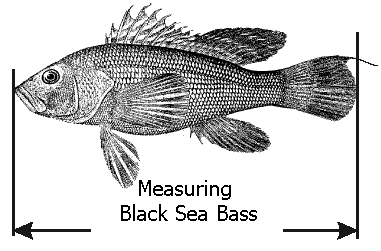
Black Sea Bass Black sea bass are measured along the midline from the snout to the end of the central portion of the tail, not to include the tail filaments. Recreational Season: See Saltwater Regulations for current size & limits For the most current regulations, go to NJfishandWildlife.com/njregs.htm#marine or call the marine fish "listen only" information line at (609) 292-2083. |
 |
Bluefish The possession limit for bluefish is 15 fish. This includes juvenile bluefish commonly known as snappers. Recreational Season: See Saltwater Regulations for current size & limits |
Black Drum Recreational Season: See Saltwater Regulations for current size & limits |
Red Drum Recreational Season: See Saltwater Regulations for current size & limits |
Shark For updates, vist their website at www.njfishandwildlife.com/saltwater.htm or call the 24-hour marine fish information number at 609-292-2083 For Detailed information on prohibited and fishable species, regulations, permits, etc: Recreational Season: See Saltwater Regulations for current size & limits |
Striped Bass (includes Hybrid Striped Bass) Anglers participating in the Striped Bass Bonus Program (click link for additional info) may possess an additional striped bass. |
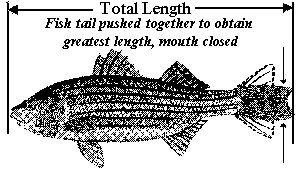 |
| It is illegal to take, catch or kill any striped bass form or in any marine waters of this state, by means of a net of any description, or by any methods other than angling with a hook and line or by spear fishing. It is illegal to possess any striped bass, or parts of a striped bass from which the head and/or tail has been removed (other than while in preparation or being served as food), which is less than the legal minimum size. Harvest and possession of striped bass from federal waters (outside 3 miles) is prohibited. Sale of striped bass in N.J. is prohibited. Note: Non-offset circle hooks are required to reduce striped bass bycatch mortality while fishing with natural bait during the striped bass springtime spawning area closure within the Delaware River and its tributaries. This restriction does not apply to hook sizes smaller than size 2. * Recreational Season: See Saltwater Regulations for current size & limits |
Summer Flounder (Fluke) Anglers may fillet one legal-sized summer flounder from their daily possession limit catch for use as bait. This carcass, commonly known as the rack, shall be kept intact so it can be measured for uke with the minimum size limit. No parts of any summer flounder caught on a previous fishing trip shall be in possession; only fish just caught on this outing. IE: no pre-prepared fluke bellies salted in a jar - you can only use a freshly caught fish on the day you are out fishing. Recreational Season: See Saltwater Regulations for current size & limits |
Tautog (Blackfish) Recreational Season: See Saltwater Regulations for current size & limits |
Weakfish (Gray & Spotted Seatrout) Recreational Season: See Saltwater Regulations for current size & limits |
Winter Flounder Recreational Season: See Saltwater Regulations for current size & limits |
Additional Marine Fishing Regulations Recreational Season: See Saltwater Regulations for current size & limits |
| National and NJ Saltwater Angler Registry Program |
| NEW JERSEY FREE ANGLER REGISTRY Anglers Must Register In NJ Or Face Fines Of Up To $3,000 (**May be subject to change) According to the state DEP website: WHO NEEDS TO REGISTER? NOTE: Anglers with a valid registration with the National Saltwater Angler Registry or have a valid license from another exempted state are required to register (for free) with the NJ Saltwater Recreational Registry Program. Registration with NJ will exempt you from having to register with the National Saltwater Angler Registry. Individual saltwater anglers ages 16 and older MUST register if ANY of the following criteria are met:
Recreationally fish in the marine and fresh tidal waters of the State of New Jersey Recreationally fish in marine waters outside the State of New Jersey but land the catch in New Jersey
OR Carry individuals who engage in recreational fishing in the marine waters outside the State of New Jersey but land their catch in New Jersey Please visit the following links for more information. SaltwaterRegistryNJ.com FAQ Section At this time, registration is FREE and can only be done ONLINE. There is no phone number to call to complete the registration. |
| Delaware Fishing License Requirement |
| A Delaware fishing license is now required for anglers aged 16 and over fishing the Delaware River and Delaware Bay between the upstream tip of Artificial Island and the Delaware-Pennsylvania state line. In that section of the river, the Delaware state boundary extends to the New Jersey shoreline. When fishing from shore in New Jersey along that section of the river, a Delaware fishing license is not required. Delaware fishing license information can ge found at http://www.fw.delaware.gov/fisheries/pages/newfishinglicense.aspx |
| New York Licence Requirement |
| New York's marine fishing license has been suspended. New York is offering a free registry to all marine anglers. Visit http://www.dec.ny.gov/permits/54950.html |
| Bait Fish |
No license is required for the taking of baitfish in salt water for personal use with the following gear:
No person shall take or attempt to take fish by any means from the Deal Lake flume, Lake Takanasse spillway or Wreck Pond spillway on any Monday, Wednesday or Friday during the months of April and May. |
| Crustaceans |
| American Lobster |
 |
| Lobster parts
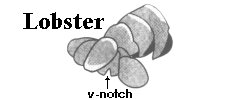
may not be possessed at sea or landed. There is no harvest or possession of lobster in Lobster Management Area 4 from April 30 – May 31 and Lobster Management Area 5 from February 1 – March 31. See Saltwater Regulations for current size & limits No person shall possess any lobster with eggs attached or from which eggs have been removed or any female lobster with a v-notched tail, as illustrated below. Special Lobster Restrictions: No person shall use, leave, deploy, or tend any lobster, fish or conch pot within an artificial reef located in state waters except in areas designated as a full access zones. Within these designated full access zones lobster, fish and conch pots shall be used, left, deployed or tended only between sunrise and sunset. For information about lobster pot deployment and New Jersey Reef Full Access Zone Locations, go to http://www.NJFishandWildlife.com/pdf/2019/marlet-reefgear02-11-16.pdf. r02-11-16.pdf. The use of spears, gigs, gaffs or other penetrating devices as a method of capture for lobsters is prohibited. A recreational lobster pot license is required to use pots or traps to capture lobsters. For details call (609) 748-2020. Lobsters taken recreationally may not be sold or offered for sale. |
Blue Claw Crabs
To see law: Go to Bio-Degradable Doors and Turtle Extruders---NJ Fish & Game Page (Scott's Bait and Tackle: We carry traps and turtle excluders to comply with the 1998 law.) |
| Horseshoe Crabs |
| The harvest of horseshoe crabs is prohibited. Possession of horseshoe crabs is also prohibited except for those individuals holding a scientific collecting permit for research and education and those fishermen that can provide suitable documentation that the horseshoe crabs in their possession were harvested outside of New Jersey. |
| Mollusks (Shellfish) |
|
Summary of NJ Saltwater Regulations
for Detailed Information!
Return to Regulations Index | NJ Record Fishes | FishIDGuide